
 Select Language
 English
Turning Bulky EPE Into Reusable Value: How an EPE Foam Recycling Machine Makes EPE Recycling Practical
Expanded polyethylene (EPE) is everywhere in modern logistics: protective corner blocks for appliances, cushioning for electronics, and shock-absorbing inserts for e-commerce parcels. Its performance is excellent, but its end-of-life reality is frustrating. EPE is mostly air, so a small amount of weight can occupy a huge amount of space. That “low density, high volume” profile is one reason many facilities still treat EPE as a disposal problem instead of a recyclable resource. Yet the broader recycling context is pushing hard in the opposite direction: globally, only about 9% of plastic waste was ultimately recycled (after accounting for recycling losses) in 2019, highlighting how much value is still being lost in linear systems.
When we narrow the lens to packaging, the opportunity becomes even clearer. In the EU, plastic packaging recycling has improved over time, and Eurostat reported that 41% of plastic packaging waste was recycled in 2022. That number is encouraging—but it also implies that the majority of plastic packaging still isn’t recycled, and bulky formats like foam remain among the hardest streams to collect and move efficiently. Academic reviews of EPE circularity echo this challenge, noting that EPE recycling is currently limited, even though multiple recycling routes are technically possible. This is exactly where an EPE-focused foam recycling machine changes the economics: it tackles the logistics bottleneck first, making collection and transport realistic, and only then does it unlock stable downstream reuse.
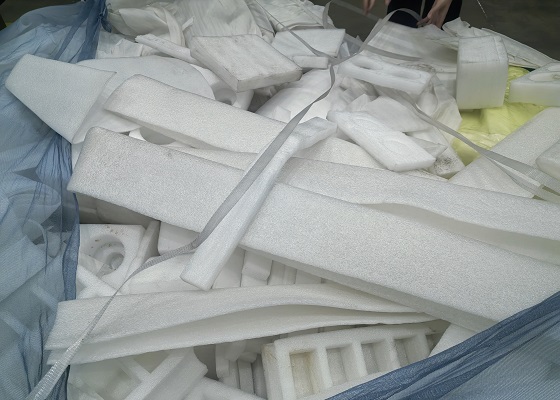
It also helps to understand how EPE sits beside EPS in the packaging world. EPS (expanded polystyrene) still dominates many high-volume protective and insulated packaging applications, while EPE is often chosen for resilience, flexibility, and multi-use performance. Using market-size estimates as a practical proxy for “usage ratio,” expanded polystyrene for packaging was estimated at USD 13.2 billion in 2024, while the EPE foam packaging market was projected at USD 3,727 million in 2024—suggesting EPS packaging is roughly 3.5× larger than EPE packaging by revenue in that year. In real operations, both materials frequently appear together in inbound streams, so a recycling setup that can handle mixed foam flows is often the most operationally efficient approach.
So what does an EPE foam recycling machine actually do for EPE recycling? The most common mechanical pathway starts with size reduction (cutting or crushing) so the foam can feed consistently, followed by densification so it becomes a transportable commodity. Densification can be achieved via cold compaction or heat-assisted melt densification. As a reference point for what densification accomplishes, hydraulic systems often cite up to 50:1 densification for EPS through compressive force, while hot-melt densifiers commonly describe volume reduction on the order of 90:1 (the exact result varies with foam type and operating conditions). For EPE, that volume collapse is the breakthrough: once foam becomes dense blocks or ingots, it stops being “air you pay to haul” and starts behaving like a manageable recyclable feedstock.
.jpg)
From there, EPE has credible reuse routes because it is polyethylene-based. In a technical recycling guideline for ARPAK EPE, JSP explains that collected EPE can be shredded and reused as “regrind,” or shredded and re-extruded back toward base PE resin as “repro,” which can be sold as recycled PE or blended with virgin resin to make new products. In other words, when a foam recycling machine stabilizes the input stream and densifies it, the material can re-enter polymer processing value chains rather than ending as disposal.
A concrete example of this “logistics first, circularity next” approach is a recent GREENMAX case in Oregon. In the project, a nonprofit Producer Responsibility Organization (CAA) was trying to build a scalable foam recovery program across dispersed collection points. The case describes how transport limits and compliance pressure made loose foam handling a dead end, and how CAA ultimately deployed a custom GREENMAX M-C300 foam densifier designed to process both EPS and EPE in a real-world network. The configuration emphasized workflow and multi-site practicality, including separate crushing and feeding chambers, quick switching between EPS and EPE, and a vehicle-mounted independent crushing design to support mobile handling across collection locations. The key insight is that the project was treated as a system design problem—collection to transport to processing—so the foam recycling machine became the anchor that made the whole EPE recycling pathway traceable, repeatable, and easier to scale.
.jpg)
EPE will keep growing with e-commerce, electronics, and appliance logistics. The question is whether it stays a cost center or becomes a material stream with measurable value. In practice, an EPE-capable foam recycling machine is the bridge: it turns “bulky and uneconomic” into “dense and tradable,” and it allows EPE recycling to connect with downstream reprocessing routes that already exist for polyethylene.