 Select Language
 English
EPS Recycling in Retail: What the Numbers Say and How Stores Turn Foam Waste into Feedstock
Retail is one of the most important “behind-the-scenes” engines of EPS recycling because stores sit at the end of a long distribution chain where protective foam packaging finally becomes waste. Think of appliance and electronics cushioning, pharmaceutical cold-chain shippers, and seafood transport boxes: all of these arrive clean enough to recycle, yet bulky enough to overwhelm back-of-house space if they are handled loosely. This is why many successful programs focus on retail and retail-adjacent collection points, where foam is concentrated, predictable, and easier to keep uncontaminated.
The clearest large-scale dataset that captures retail-generated foam is the North American EPS transport and protective packaging stream, where “post-consumer” explicitly includes material generated by commercial facilities as end-users and also includes returns from the distribution chain. In the 2022 Expanded Polystyrene Recycling Report, total EPS recycled was reported at 168.6 million pounds, including 61.6 million pounds of post-consumer EPS. Because retail stores and retail distribution centers are classic “end-users” of protective packaging, these post-consumer figures are a practical indicator of how much EPS recycling is already happening in channels closely tied to retail operations.
.jpg)
Trade reporting around that same period reinforces the point that EPS recovery is strongest where businesses control their own collection and logistics. A Resource Recycling Systems (RRS) survey cited by Waste Today found that about 84,000 tons of EPS were diverted from landfills and recycled in 2022, and that EPS transport packaging reached an estimated 31% recycling rate in the United States and Canada, driven primarily by business-to-business systems and alternative channels rather than traditional curbside collection. Retail is a natural fit for this model: stores can bale or densify foam on-site, keep it dry and segregated, and contract directly with haulers or recyclers.
In Europe, retail-linked EPS is especially visible in seafood and fresh-food supply chains. The European Commission’s LIFE project documentation notes that around 335,000 tonnes of EPS are used in the EU every year for fish boxes, yet only about 25% of this packaging is recycled in Spain and other southern European countries, while northern markets such as Denmark can reach around 80%; it also notes that a significant share is incinerated or landfilled due to collection and cleanliness challenges. Where collection is organized, performance can be very high: an EUMEPS fact sheet reports fish box recycling rates reaching about 90% in several countries, with other markets not far behind. For retailers, this translates into a simple operational truth: when foam is captured at the store, kept clean, and made economical to transport, EPS recycling rates jump.
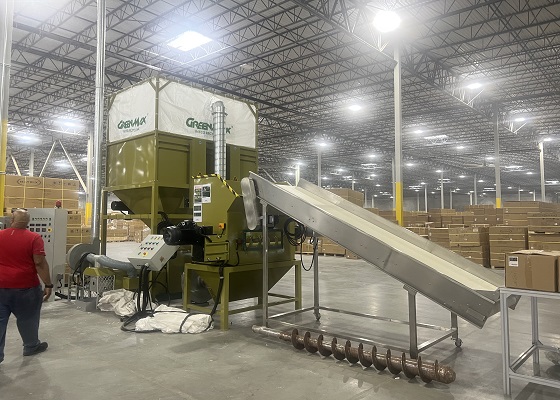
That “economical to transport” part is where compaction equipment changes outcomes in retail backrooms. A real European example comes from C.T.C. Servicios Ambientales, a waste-management company that decided to start collecting bulky EPS packaging specifically from supermarkets because many stores had large volumes that were costly to dispose of. GREENMAX provided an EPS recycling machine solution using an A-C300 compactor, and as volumes grew C.T.C. later purchased another higher-capacity A-C300; the case also describes the A-C300’s automatic cutting feature and supporting accessories like a conveyor and silo to reduce labor while producing consistent EPS blocks. Importantly for retail-style throughput, the same case notes that C.T.C. operated the A-C300 for about eight hours per day, and the compacted EPS blocks were sold onward to local granulators, turning supermarket foam into a tradable feedstock.
Retail-focused collection is also expanding through programs that make drop-off and densification easier. EPS Industry Alliance communications have highlighted the growth of drop-off locations and densifier-supported programs; for example, one industry update noted foam polystyrene collected for recycling from Foam Recycling Coalition–supported programs rose from 841,000 to 1.6 million pounds between 2019 and 2023 as access expanded.
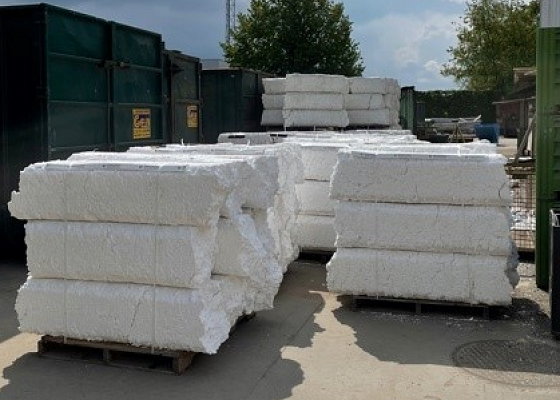
When retail stores treat foam like a recoverable material instead of “air that takes up space,” EPS recycling becomes a repeatable business process. The data shows meaningful tonnage is already being captured through commercial and distribution-chain channels, and the C.T.C. supermarket case illustrates the operational pathway: collect clean back-of-house EPS, densify it with a GREENMAX EPS recycling machine, then ship compact blocks into recycling markets that can actually use them.