
 Select Language
 English
Using polystyrene compactors to close the loop on EPS seafood boxes in Europe
Expanded polystyrene (EPS) fish boxes are everywhere in Europe’s seafood value chain. They keep fish cold from landing site to retail counter, but they also generate a huge stream of bulky waste. As the EU consumes around 10.3 million tonnes of seafood per year, or roughly 23 kg per person, even small inefficiencies in packaging quickly turn into mountains of foam.
Across the EU, about 335,000 tonnes of EPS are used every year for fish boxes alone, making this the single largest EPS packaging application in the seafood sector. These boxes are technically 100% recyclable, yet recent analyses suggest that only around 27% are recycled, about 40% go to waste-to-energy, and the rest end up in landfill; in some regions, 45–50% of fish boxes are still landfilled. That gap between technical recyclability and real recycling performance is where polystyrene compactors are starting to make a difference.
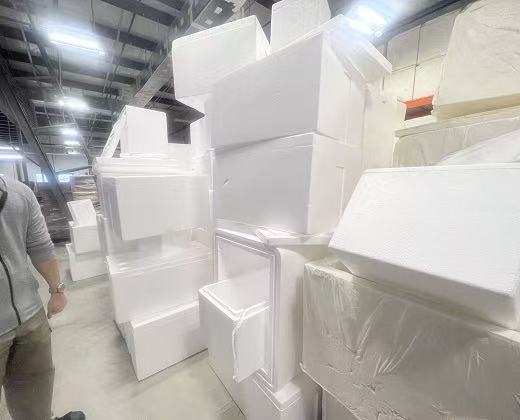
Where EPS boxes become waste along the seafood chain
Ocean-focused projects in the Atlantic EU countries have mapped how EPS fish boxes move through the market and where they turn into waste. Key stages are:
Packaging and landing: Fish farms and fishing vessels pack fresh fish in EPS boxes for shipment to auctions and processing plants. Broken boxes and offcuts are an early source of industrial waste.
Processing and primary distribution: Processors, aquaculture companies, wholesalers and logistics hubs receive product in EPS, re-pack, and often ship again in new EPS boxes. Each transfer generates broken or contaminated boxes.
Wholesale markets and large distribution centres: Central fish markets and big distribution chains handle large volumes of boxed fish. Here, boxes usually become commercial waste managed by private waste companies.
Retail, food service and HORECA: Supermarkets, fishmongers, restaurants and hotels receive fish in EPS and discard empty boxes into commercial or municipal systems.
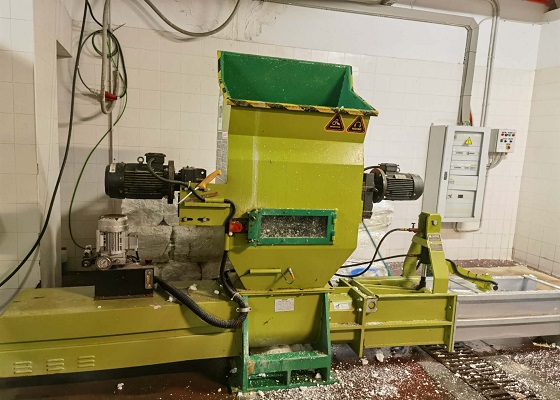
Why compaction is a game changer
EPS is about 98% air and only 2% polystyrene, which is why a single truck can quickly fill up with almost no real weight. Uncompacted boxes take up so much space that transporting them to specialist recyclers is often uneconomic, especially from remote ports or scattered retail sites. A typical polystyrene compactor shreds and cold-densifies used boxes into high-density blocks or briquettes, reducing volume by roughly 50:1 (over 90% volume reduction).
European case
Across Europe, multiple practical examples show how polystyrene compactors are already changing EPS fish-box management:Danish and North Sea fishing ports: In one North Sea region, waste from more than 1.3 million EPS fish boxes per year arriving from several EU countries is now collected at the harbour and compressed into roughly 100-kg blocks before being shipped to recyclers in southern Europe. Without on-site compaction, transport costs and storage constraints would have made such a scheme unworkable.
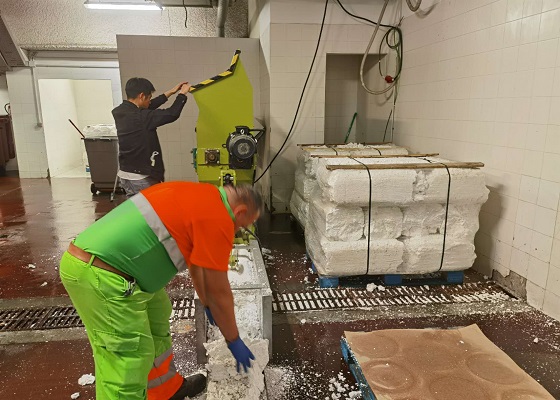
Polystyrene compactors are not a silver bullet—Europe still needs better collection schemes, stronger incentives and, in some cases, alternative packaging. But the evidence from ports, markets and processors shows that densifying EPS at source is one of the fastest, most practical levers to unlock high-quality recycling of expanded polystyrene fish boxes while keeping Europe’s seafood moving safely through the cold chain.