
 Select Language
 English
Unlocking the Value of Foam Waste with GREENMAX Recycling Solutions
Foam waste is often seen as difficult to handle because it is light in weight, large in volume, and expensive to store or transport. Yet in reality, with the right foam recycling machine, used foam can be converted from a disposal problem into a reusable material stream. For manufacturers, warehouses, logistics centers, appliance suppliers, and packaging users, the challenge is not whether foam can be recycled, but how to recycle it efficiently and economically. This is exactly where GREENMAX solutions have practical value, especially through three key types of equipment: the foam densifier, the foam compactor, and the foam crusher.
A foam recycling workflow often begins with volume reduction. Many types of foam, including EPS, EPE, EPP, PSP, and XPS, occupy large amounts of space but contain relatively little actual material. This means companies often pay high logistics costs for moving air rather than moving plastic. A GREENMAX foam densifier solves this problem by using heat to melt and densify foam into compact ingots that are easier to store, transport, and resell. In GREENMAX’s own product positioning, this type of melting solution is built to support continuous feeding, compact installation, safer external heating, and plate-shaped ingot output that is easier to handle and store. It is also designed to process multiple foam materials, including EPS, PSP, XPS, EPE, and EPP, which makes it useful for different recycling scenarios rather than only one narrow application.
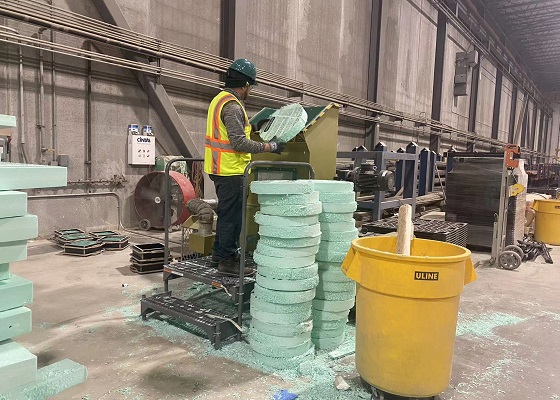
A practical case for a GREENMAX foam densifier can be seen in export-oriented packaging operations or appliance distribution centers where large quantities of used EPS packaging are generated every day. In these environments, foam waste usually accumulates quickly in storage areas and creates a major logistics burden because the material is so bulky before treatment. Instead of sending loose foam to an outside recycler, the company can install a GREENMAX foam densifier on site and process the waste immediately into dense ingots. This greatly reduces storage pressure, cuts transportation frequency, and improves the resale value of the recovered material. For companies that want to turn foam waste into a more tradable recycled product, the densifier is not simply a volume-reduction machine. It is a way to stabilize internal recycling operations and make downstream handling more commercially efficient.
The second major solution is the GREENMAX foam compactor, which uses cold compression rather than melting. This is especially useful for companies that want to reduce foam volume while keeping energy consumption relatively low and simplifying on-site handling. One internal GREENMAX case focuses on EPP foam recycling, showing how compactors address one of the biggest barriers in foam recovery: low density. The case notes that compacting foam into dense blocks or ingots can reduce volume by up to 50%, significantly lowering transportation and storage costs while making recycling more economically feasible.
In that GREENMAX compactor case, a European automotive parts manufacturer producing EPP-based components such as bumper cores and seat structures faced rising scrap-handling costs as offcuts and defective parts accumulated on the factory floor. By installing a foam compactor, the company was able to compress production waste into high-density blocks directly on site. Those compacted blocks could then be sold to recyclers or reused internally for non-critical components, helping the company reduce waste-handling costs and improve factory efficiency. Another GREENMAX case involved a global electronics distributor using EPP returnable packaging. Damaged or end-of-life foam inserts had previously been discarded or transported in bulky form, leading to high logistics costs. After implementing a foam compactor at its distribution center, the company could densify EPP waste on site, reduce transportation frequency, and establish a more closed-loop recycling system.
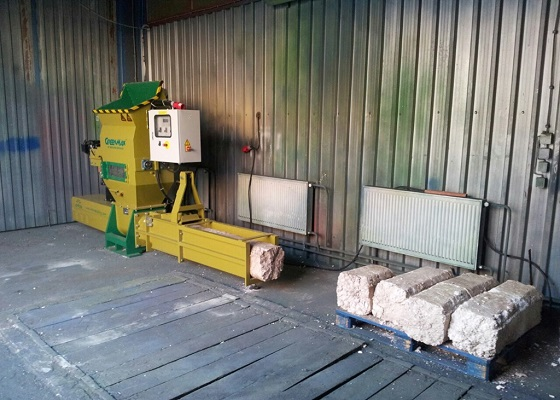
The third essential machine in many foam recycling lines is the foam crusher. While densifiers and compactors focus on reducing final volume, the crusher plays a critical upstream role by breaking down large foam pieces into smaller, more manageable sizes. This improves feeding stability, supports continuous processing, and helps companies handle irregular foam waste more efficiently before compaction, melting, or pelletizing. In practical terms, a GREENMAX crusher is especially valuable for packaging plants, appliance suppliers, and logistics sites where incoming foam waste includes bulky molded parts, corner protectors, foam sheets, and mixed offcuts.
A typical GREENMAX crusher case can be seen in a warehouse or manufacturing setting where foam waste comes in different shapes and sizes. Without size reduction, the material is often difficult to feed consistently into downstream recycling equipment. By using a crusher first, the company can create a more uniform material stream, reduce manual cutting work, and improve the operating efficiency of the overall line. The crushed foam can then be sent either to a compactor for cold compression or to a densifier for thermal melting, depending on the target output and recycling plan. This kind of front-end preparation makes the entire recycling process smoother and more reliable.
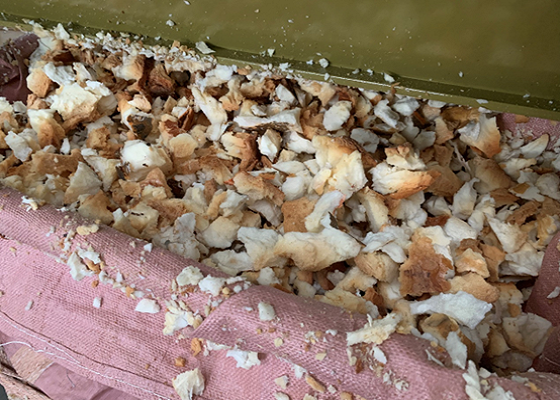
What makes GREENMAX foam recycling equipment especially useful is not only that each machine solves a separate problem, but that these systems can also work together as part of a more complete recycling process. A crusher improves material preparation, a compactor reduces volume through cold pressing, and a densifier produces dense melted ingots with higher transport and resale value. Depending on the material type, plant conditions, and recycling objective, companies can choose a single machine or build a more integrated line.
In the end, foam recycling is not just about waste reduction. It is about turning bulky, low-density material into something manageable, tradable, and reusable. GREENMAX foam densifiers, foam compactors, and foam crushers each contribute to that goal in different ways. For companies looking to reduce disposal costs, save storage space, and strengthen recycling performance, these machines provide a practical path from foam waste to resource value.