 Select Language
 English
Turning Styrofoam Waste into a Circular Resource with a Styrofoam Densifier
Styrofoam, also known as expanded polystyrene (EPS), is everywhere—protecting televisions, refrigerators, medical supplies, seafood shipments, and countless e-commerce deliveries. Yet the very qualities that make EPS useful also make it difficult to recycle. It is light, fragile, and voluminous, so a small amount by weight can overwhelm a facility’s bins and occupy valuable floor space. Because hauling is priced largely by volume rather than weight, many businesses end up paying repeatedly to move “air,” even when the foam itself is clean and technically recyclable. A styrofoam densifier changes the economics by transforming loose EPS into dense, uniform blocks that are easy to store, transport, and sell as recycling feedstock.
A densifier compresses EPS through mechanical force and controlled heating or friction, reducing its volume dramatically and stabilizing it into a solid form. Instead of bags of loose foam that scatter, attract contamination, and require frequent pickups, the output becomes stackable blocks with predictable density. This simple shift creates a reliable material stream: businesses can collect foam at the source, densify it on-site, and ship it in scheduled loads rather than emergency hauls. For many generators of EPS—distribution centers, appliance retailers, manufacturers, and cold-chain operators—densification is the missing link that makes recycling practical.
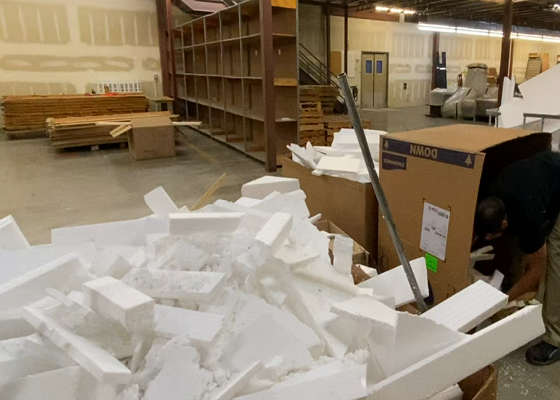
One North American distribution hub provides a clear example of how this works in daily operations. The site handled high volumes of inbound packaged goods and accumulated a steady flow of clean EPS corners and panels. Previously, the foam was stored in large cages that filled quickly, creating congestion and pushing staff to request pickups more often than planned. Costs rose, and recycling was inconsistent because transport was inefficient and the material was hard to manage. After installing a GREENMAX styrofoam densifier near the unpacking area, the facility began processing foam immediately as it was generated. Operators fed EPS into the machine throughout the day, and the densifier produced compact blocks that could be palletized neatly in a designated corner of the warehouse. Within a short period, the site regained space, reduced handling time, and turned a chaotic waste stream into an organized routine.
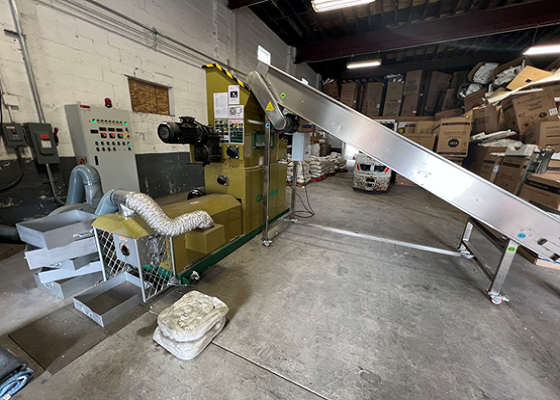
What made the project especially effective was that GREENMAX supported more than the equipment. Alongside supplying the densifier and helping the team establish an operating workflow, GREENMAX also offered a buy-back pathway for the compressed styrofoam blocks. Instead of asking the facility to “find a recycler,” GREENMAX created a clear outlet for the densified material, enabling the site to treat EPS as a recoverable resource rather than a recurring disposal cost. The blocks could be stored until they reached shipping quantity, then moved through a defined channel where the densified EPS entered downstream recycling processes and reappeared as raw material for new products.
This combined “densify and buy-back” model is a practical expression of circular economy principles. The generator benefits from lower logistics costs, cleaner operations, and the possibility of monetizing a previously negative-value waste stream. The recycler benefits from consistent, transport-efficient feedstock that can displace virgin plastic. Most importantly, EPS gets a second life instead of ending up in landfill. By pairing reliable on-site densification with a committed take-back option, GREENMAX helps businesses close the loop—turning styrofoam from a stubborn problem into a measurable circular resource.
.jpg)