 Select Language
 English
Turning Bulky EPS Into a Shippable Commodity: Styrofoam Recycling with a Densifier-Why GREENMAX Stands Out
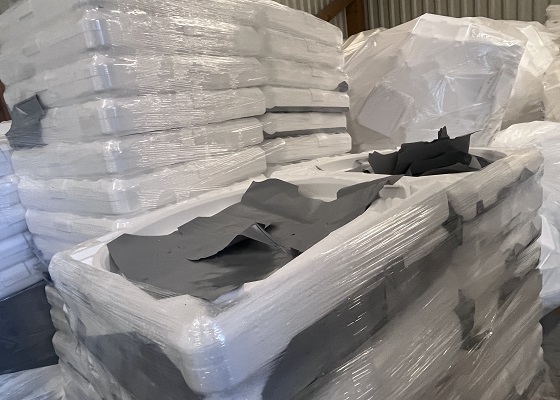
Expanded polystyrene (EPS)—often called “Styrofoam” in everyday conversation—is a workhorse material for packaging and insulation, but it’s a headache once it becomes waste. The core issue is density: EPS is mostly air (commonly described as about 98% air), which makes it lightweight but extremely bulky to store, handle, and transport.
That’s exactly where a styrofoam densifier earns its keep. Instead of hauling “truckloads of air,” a densifier converts loose EPS into dense blocks or ingots that can be stacked, stored safely, and shipped economically to downstream recyclers.
How Styrofoam Densification Recycling Works
Most EPS densification programs follow a simple, scalable loop:
Collection & Sorting
EPS is gathered from packaging lines, warehouses, retail backrooms, distribution centers, or municipal drop-off points. Clean, single-material streams usually create the highest-value output.Pre-processing
Oversized pieces may be broken down for easier feeding. Some operations add a shredder/grinder upstream; others feed whole pieces directly, depending on the densifier design and material form.Densifying
The densifier compresses (and in some systems, partially heats/softens) EPS into compact, consistent blocks. The main win is volume reduction—turning a storage problem into a manageable product.Storage, Logistics & Recycling
Densified EPS can be stored in a small footprint and shipped less frequently. From there, it’s commonly reprocessed into pellets or other raw material formats for manufacturing.
Advantages of the GREENMAX Styrofoam Densifier
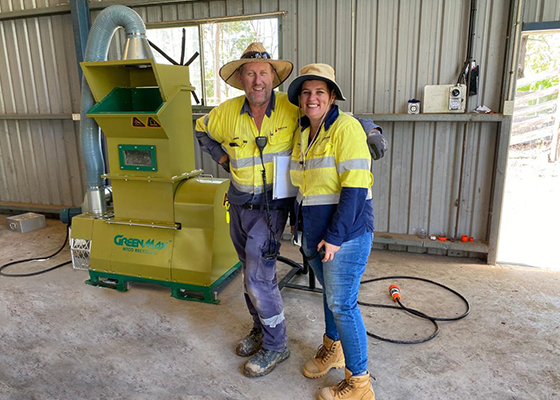
GREENMAX styrofoam densifiers are designed to make EPS recycling practical in real-world operations—where floor space, labor, and freight costs are always under pressure. Key advantages include:High volume reduction for lower freight and storage cost
GREENMAX notes that its foam densifier can compress foam waste by up to 90:1, dramatically improving transport efficiency.Versatility across multiple foam types
Many facilities deal with more than EPS alone. GREENMAX highlights designs intended to handle EPS, EPE, and XPS, which helps standardize recycling across product lines.Simplified operation and labor efficiency
In one customer story, the densifier was described as easy enough that even a delivery driver could run it, and the process required only one worker.Practical service model for businesses that don’t want to hunt for buyers
A common bottleneck is “What do we do with the blocks?” In the same case, GREENMAX described a buy-back service for compressed foam blocks—helpful for sites that want a clearer downstream path.Scales from small sites to multi-location networks
Densification is modular: you can start with one site (or one machine) and expand as volumes grow—without redesigning your entire waste operation.
.jpg)
North America Case: Top-Line Furniture
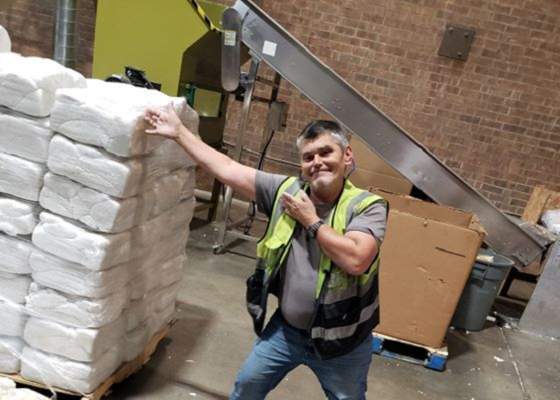
A practical example comes from Top-Line Furniture Corp., a furniture distribution company founded in 1995 with multiple distribution points across North America. As its business expanded, Top-Line generated increasing amounts of EPS packaging waste from distribution operations, and managing bulky foam became a growing challenge.
After researching solutions, Top-Line selected a GREENMAX foam densifier M-C50 for EPS packaging recycling. The reported results were operationally meaningful:
Only one day of operation per week was needed to handle about a week’s worth of accumulated foam.
The machine was described as easy to operate, and the workflow required just one worker, reducing labor burden.
GREENMAX also described offering a buy-back pathway for the densified foam blocks, which can simplify outbound logistics for sites that don’t have an established recycler relationship.
For many North American generators—especially distribution, retail, furniture, and appliance supply chains—this “one day per week” model is exactly what makes EPS recycling workable: densify on a schedule, keep storage under control, and ship only when it’s cost-effective.
3 Industry Q&A
Q: What level of contamination can a densifier handle (labels, tape, food residue)?A: Densifiers work best with clean, dry EPS. Light labels/tape are often manageable depending on downstream requirements, but food contamination typically reduces recyclability and value. If your stream is “dirty foam,” consider adding sorting/cleaning steps—or choose equipment designed for contaminated EPS.
Q: How do I choose between a cold compactor vs. a hot-melt densifier?
A: It depends on your foam type, space, and shipping model. Hot-melt systems often achieve very high volume reduction and stable output; cold compaction can be simpler for certain clean EPS streams. The right choice is usually driven by (a) volume, (b) contamination, (c) labor availability, and (d) downstream buyer specs.
Q: What does ROI typically depend on for EPS densification?
A: The biggest drivers are avoided hauling costs (fewer pickups), freed warehouse space, labor saved from manual handling, and whether you have a reliable outlet (buyer/buy-back) for densified blocks. Many sites justify a densifier primarily on logistics savings—then treat material revenue as upside.