
 Select Language
 English
Styrofoam Recycling in Europe: Why a Styrofoam Compactor Matters and Where the Foam Comes From
In everyday conversation, “styrofoam” usually refers to polystyrene foam, most commonly EPS (expanded polystyrene) used for packaging and, in some applications, insulation. Europe’s challenge is not whether this foam can be recycled, but whether it can be collected and transported efficiently enough to make recycling economical. Because foam is mostly air, loose material fills containers quickly, drives up haulage frequency, and often gets treated as “too bulky to bother.” That is exactly where a styrofoam compactor changes the equation: by turning voluminous foam into dense blocks, it lowers transport costs, improves storage safety, and helps recyclers secure a consistent, clean feedstock stream.
Across Europe, industry monitoring shows both progress and big differences between countries. EUMEPS reports that about 507 kilotonnes of EPS packaging and construction waste were collected in Europe in 2019, and that packaging was the dominant waste category with a 73% share. In the same dataset, Europe’s total EPS recycling rate was 30%, with packaging applications at 38% and construction at roughly 10%. These figures help explain why compaction is so widely adopted: when you’re dealing with light material at continental scale, logistics frequently determines whether material is recycled or discarded.
Country performance varies widely, and the packaging stream typically leads because it is cleaner and easier to separate. In 2019, EUMEPS highlighted particularly high EPS packaging recycling rates in several markets, including Portugal at 83% and Norway at 76%, followed by Denmark at 60% and the Netherlands at 59%. Austria and the United Kingdom reached 56%, while Ireland and Belgium were reported at 52%. These national results show that “styrofoam” recycling isn’t a single European story; it’s a patchwork shaped by collection systems, end markets, and how well bulky foam is handled at the source.
Germany offers a useful look at how different channels affect outcomes. A Conversio/IVH survey summarized by BKV reports that 70,000 tonnes of EPS packaging waste were generated in Germany in 2021, split between household and industrial/commercial streams. The recycling rate for industrial and commercial EPS packaging waste was 83%, while only 6% (about 2,000 tonnes) of household EPS packaging was recycled, largely because it is not consistently captured in the primary lightweight-packaging collection routes. The same summary reports an EPS construction-waste recycling rate of 65.8% in 2021. The lesson is straightforward: cleaner, better-sorted foam streams are far more likely to be recycled, and compaction helps keep them clean and manageable.
.jpg)
So where does most European “styrofoam” come from? Packaging is the biggest driver, and within packaging, EUMEPS notes that growth has been pushed mainly by food transportation, including fish boxes, while cushioning used for technical and electronic appliances remains a major, steady source. Construction contributes too, especially installation cut-offs and, increasingly, demolition waste as insulation retrofits and building renovations accelerate. Because these sources are often concentrated at ports, food distribution hubs, appliance plants, and building sites, placing a styrofoam compactor close to the point of generation can quickly improve capture rates.
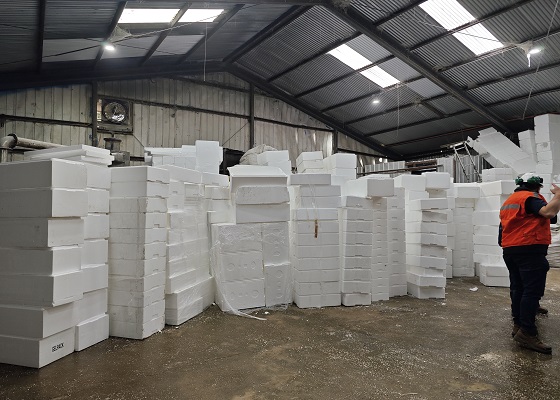
A practical European example comes from Spain. GREENMAX documents how C.T.C. Servicios Ambientales, a Spanish waste-management company, encountered growing demand for styrofoam disposal services from large clients such as supermarkets. To scale recycling efficiently, C.T.C. adopted GREENMAX’s solution and invested in additional equipment, including a foam compactor A-C300 with features such as automatic cutting. In operational terms, this kind of GREENMAX styrofoam compactor setup allows a collector to accept more foam from customers without being overwhelmed by volume, store dense blocks instead of loose packaging, and ship more value per truckload—turning a costly, space-hungry waste stream into a tradable material flow.
.png)
Ultimately, Europe’s styrofoam recycling performance depends on two fundamentals: reliable collection and economical transport. The data show that when systems exist, high recycling rates are achievable, especially for cleaner packaging foam streams. And on the ground, a styrofoam compactor is often the simplest lever to pull—because once the air is removed, the rest of the recycling chain becomes dramatically easier to run.