 Select Language
 English
Recycling of Styrofoam special-shaped packaging cutting scraps - Application of Styrofoam Melting Machine
Styrofoam is widely used in the packaging industry, particularly for custom-shaped packaging, due to its excellent cushioning, thermal insulation, and lightweight properties. However, the large amount of leftover material generated during the production process, if not properly handled, not only takes up space but also causes environmental pollution. Fortunately, the advent of Styrofoam melting machines provides an effective solution for recycling this leftover material.
Styrofoam's closed structure provides excellent cushioning, thermal insulation, water resistance, and buoyancy. For packaging items requiring special protection, such as electronics, glassware, and precision instruments, custom-shaped Styrofoam packaging can be tailored to the product's shape, providing precise protection. However, this customized production inevitably generates significant scrap. Because Styrofoam is resistant to aging and degradation, traditional disposal methods, such as landfilling, consume significant land resources and remain indecomposable for decades or even centuries. Incineration, on the other hand, produces toxic and harmful gases, polluting the air and harming human health and the environment.

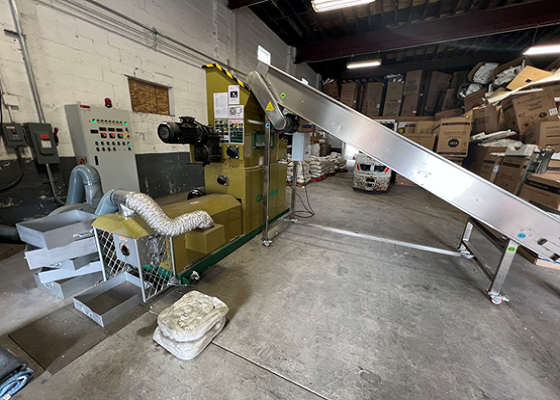
The crushed Styrofoam pieces enter the hot melt area. This area is typically heated by electricity or a heat medium. For example, in the case of electric heating, the heating elements within the machine rapidly raise the temperature to the Styrofoam's melting point. Under the high temperature, the Styrofoam pieces begin to soften and melt, gradually transforming from a solid to a viscous liquid. To ensure uniform melting, some machines are equipped with a stirring device, such as a spiral agitator. This continuously stirs the material during rotation, ensuring that every section of the Styrofoam is fully heated, preventing local overheating or incomplete melting. This ensures that the material is completely converted into a uniform melt, facilitating subsequent molding or extrusion operations.
The recycled materials processed by the machine, if they are in the form of blocks or strips, can be directly packaged and stored and transported to relevant production enterprises for manufacturing low-demand packaging products, such as the inner packaging liner of ordinary products. In the case of granular recycled materials, further screening can be performed to remove possible impurities or incompletely melted particles. The screened pellets can be mixed with new raw materials in a certain proportion to produce various Styrofoam products, such as foam boards, disposable tableware, packaging boxes, etc., to realize the recycling of resources, reduce production costs, and reduce the demand for new materials.
Styrofoam raw materials are mainly derived from non-renewable resources such as petroleum. Through the recycling and reuse of leftovers, the recycling of resources is realized, and the demand for exploitation of new petroleum resources is reduced. This plays an important role in alleviating the pressure of resource shortages and promoting the transformation of the packaging industry towards sustainable development, which is in line with the current global green development concept.