
 Select Language
 English
Recycling EPE Film with a Heat-Melt Foam Densifier-From Bulky Waste to Dense Value
EPE film is everywhere in modern packaging. It protects products in transit, cushions delicate parts, and prevents surface scratches, all while remaining lightweight and clean in appearance. Yet the same properties that make expanded polyethylene useful also make it frustrating after use. EPE film takes up enormous space, clogs collection areas, and creates costly transportation runs because trucks “fill up” long before they reach a profitable payload weight. Many facilities want to recycle it, but the economics often collapse under the pressure of volume.
A heat-melt foam densifier changes the equation by addressing the core problem: density. Instead of trying to move or store EPE film in its original expanded form, the material is softened and compressed into a compact, stable output that can be handled like a standard recyclable feedstock. For operations that generate consistent volumes of EPE foam film—such as packaging plants, distribution centers, or protective-material converters—densification can turn a messy waste stream into a controllable, value-oriented process.
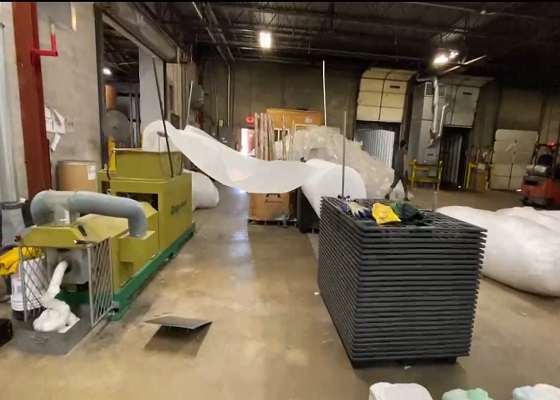
The essential concept behind a heat-melt foam densifier is straightforward. EPE film enters the machine through a feed opening and is guided into a heating and compression zone. As temperature rises to a controlled level, the polymer softens, allowing trapped air to be pushed out efficiently. Compression then consolidates the softened material into a dense form, typically discharged as continuous logs or ingots. Because the material is not simply squeezed cold, the output is less springy and more dimensionally stable. This stability matters in real-world handling: dense pieces stack neatly, take up far less space, and remain compact during storage and transportation.
When recycling EPE film, the heat-melt approach is particularly attractive because film tends to behave unpredictably during mechanical compression. Thin, flexible material can bridge over hopper openings, wrap around moving components, and feed unevenly. By combining controlled heat with a well-designed compaction mechanism, a foam densifier can process EPE foam film more smoothly and produce a more consistent density. That consistency often leads to improved acceptance by downstream recyclers, who prefer uniform input for reprocessing steps.
Beyond the obvious space savings, heat-melt densification also improves workflow. Facilities that once devoted large areas to loose film storage can reclaim floor space for production or logistics. Internal transport becomes simpler because operators move smaller, heavier bundles rather than oversized sacks of air-filled waste. Outbound shipping becomes more efficient because each pickup carries substantially more polymer by weight. Over time, these changes can reduce disposal pressure, cut hauling frequency, and improve the overall predictability of the recycling operation.
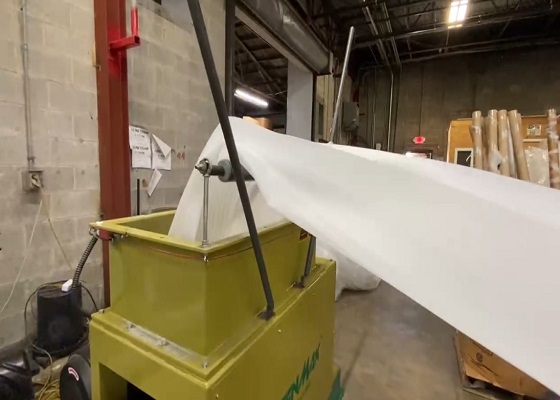
A useful example comes from a packaging operation that handled high volumes of EPE foam film from daily packing and protective wrapping. The film was relatively clean, but it accumulated so quickly that storage areas became congested. Loose film required frequent removal, yet each load delivered poor weight efficiency, making transport costs hard to justify. The company experimented with basic compaction, but the material’s resilience caused bales to expand, and the output remained awkward to stack and ship.
To solve the problem, the operation adopted a GREENMAX foam densifier special model engineered specifically for EPE foam film. The machine was configured to improve feeding behavior and reduce the chance of bridging and interruptions, which are common with film-like materials. Once the line stabilized, the heat-melt densification produced dense ingots that held their shape after discharge. The difference was immediate in day-to-day handling. Instead of rushing to remove bulky film to avoid overflow, the company could densify continuously and store output in a compact footprint. Transportation changed as well: shipments became fewer but heavier, and the output form was easier to load and stack. Perhaps most importantly, the densified EPE film became a more practical commodity for downstream recycling because the ingots were uniform and manageable, allowing the company to plan shipments around capacity and market timing rather than emergency cleanup.
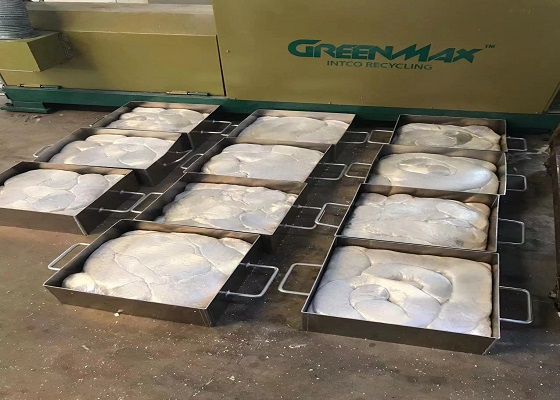
The effectiveness of a foam densifier in EPE film recycling also depends on operating discipline. Clean input is a major advantage in packaging environments, but even small amounts of contamination can complicate downstream processing. Temperature stability is another key factor: controlled heat should soften the polymer for consolidation without degrading the material. When these elements are managed properly, densified EPE film becomes a strong candidate for further recycling routes, including pelletizing or other reprocessing methods depending on local capabilities and requirements.
Recycling EPE film is often described as a volume problem more than a material problem. A heat-melt foam densifier tackles that reality directly by converting expanded, airy film into dense, transport-ready ingots. For companies seeking practical recycling outcomes—especially those with steady EPE foam film generation—this approach can transform a costly waste stream into a cleaner, more efficient, and more valuable part of daily operations.