 Select Language
 English
GREENMAX styrofoam compactor helps prevent a repeat of the "white pollution panic" across the United States after Thanksgiving
Every Thanksgiving, millions of gifts are shipped across the United States cushioned in white Styrofoam (EPS) foam. These protective blocks and sheets do an excellent job of keeping presents safe—but after the holidays, they often end up overflowing trash bins and landfills. Using a Styrofoam compactor offers a practical way to turn this seasonal “waste” into a valuable recyclable resource, and companies like GREENMAX, a brand of INTCO Recycling, are already proving how effective this approach can be.
Why Thanksgiving gift Styrofoam is a problem
Expanded polystyrene is about 95–98% air. That means a small amount of material takes up a huge amount of space in bins, trucks, and landfills. At the same time, EPS is actually 100% recyclable when collected and handled correctly. INTCO Recycling notes that EPS packaging, containers, and boxes can be recycled and turned into new plastic products instead of being landfilled.
The challenge is logistics: loose foam from Thanksgiving gifts is bulky, messy, and expensive to transport in its original form. This is where a Styrofoam compactor becomes essential.

How a Styrofoam compactor works
A Styrofoam compactor is designed to dramatically reduce the volume of EPS waste. GREENMAX compactors, for example, can compress foam at ratios up to 50:1, transforming large, lightweight pieces of packaging into dense, stackable blocks.
The typical process is:
Feeding: Collected Styrofoam packaging from gifts is fed into the hopper.
Crushing: Internal blades break the foam into smaller pieces.
Cold pressing/compacting: The machine applies pressure to squeeze out air.
Discharging: The compacted EPS comes out as solid blocks or logs, ready for storage, transport, and resale as a recyclable material.
These compacted blocks can then be shipped efficiently to recycling plants, where they are processed into pellets and used to manufacture items like picture frames, skirting boards, and other plastic products. INTCO, for instance, recycles about 100,000 tons of waste EPS each year and uses it to make new products, significantly reducing carbon emissions.
U.S. examples: turning packaging into a resource
In the United States, Styrofoam compactors have already been adopted by a wide range of organizations, including furniture retailers and local governments.
Furniture and household goods retailers: Companies such as Top-Line Furniture and other major U.S. furniture chains have partnered with GREENMAX to recycle the large volumes of EPS packaging that protect furniture during shipping. Instead of paying for disposal, they use GREENMAX machines to densify the foam and then send the blocks to recyclers, turning a disposal cost into a revenue stream.
Applying this to Thanksgiving gift packaging
A practical Thanksgiving recycling program can look like this:
Collection pointsRetailers, malls, and community centers set up bins specifically for Styrofoam packaging from gifts and holiday sales.
Clear signage explains that clean, white EPS foam (no food residue, no tape or film) is accepted.
On-site compacting
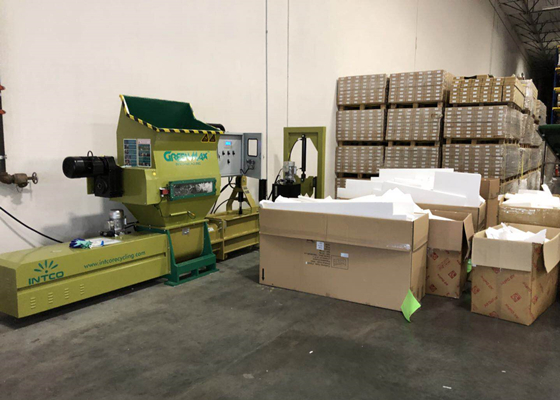
A GREENMAX Styrofoam compactor is installed at a distribution center, recycling facility, or municipal transfer station.
During and after the Thanksgiving period, collected foam is compacted daily, keeping the site tidy and minimizing storage.
Recycling and reuse
The compacted EPS blocks are sold or shipped to companies like INTCO that specialize in converting waste EPS into new products.
Environmental and economic benefits
By using Styrofoam compactors for Thanksgiving packaging, organizations can:
Reduce landfill use and visual clutter from bulky foam.Cut transportation costs, since dense blocks require far fewer truckloads than loose foam.
Create a circular material flow, where protective packaging for gifts comes back as raw material for new products.
Promote a greener brand image, appealing to environmentally conscious consumers during a high-profile holiday season.
As Thanksgiving continues to be a major gifting moment in the U.S., adopting Styrofoam compactors—especially proven systems like GREENMAX—offers a straightforward, scalable way to turn seasonal packaging waste into a sustainable resource rather than an environmental burden.
.jpg)