 Select Language
 English
GREENMAX Polystyrene Hot Melting Machine Solves Various Environmental Pollution from the Source
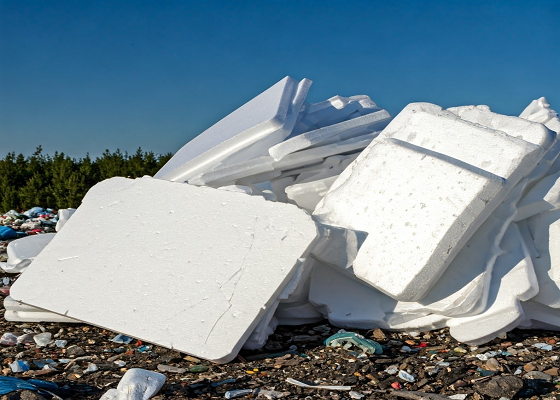
Expanded polystyrene (EPS), often known as Styrofoam, is widely used in packaging, insulation and food containers because it is light, cheap and has excellent cushioning and thermal properties. However, once discarded, these same properties turn EPS into a persistent environmental burden. When EPS is casually dumped on streets, construction sites or near rivers, it quickly escapes waste management systems and spreads into the wider environment.
Littered EPS is non-biodegradable and can persist for hundreds of years. It occupies a disproportionate volume in landfills due to its low density, wasting valuable landfill capacity. Because it is extremely light, wind and rain easily carry loose foam into drains, rivers and oceans, where it breaks into small fragments and microplastics. These particles are frequently recorded as a major component of marine litter and pose ingestion risks to fish, birds and other wildlife, as well as potential impacts on human health through the food chain.
A practical way to tackle this problem is to recycle EPS on-site using a polystyrene hot melting machine. In a typical system, collected EPS waste is pre-sorted, crushed and then fed into a heated chamber. At temperatures around 140–200 °C, the foam softens and melts, and a screw pushes the molten plastic out in a dense, continuous strand. Once cooled, this strand forms compact ingots with densities hundreds of times higher than loose foam, often achieving volume reduction ratios of up to about 90:1.
This densification has several advantages. First, it dramatically lowers storage and transportation costs: what previously required many truckloads of bulky foam can be shipped as a few pallets of dense blocks. Second, the ingots are a valuable secondary raw material that can be pelletized and turned into new plastic products such as picture frames and insulation boards, closing the loop in a circular economy approach. Third, controlled hot melting avoids uncontrolled burning or illegal dumping, thereby reducing air, soil and water pollution associated with improper foam disposal.
.jpg)
A concrete example comes from an EPS producer in South Africa. The company generated large quantities of EPS offcuts and scrap during production, which were difficult and costly to handle due to their bulk. To solve this, the producer purchased a GREENMAX Mars series polystyrene hot melting machine, a polystyrene hot melting machine specifically designed for EPS. The equipment heats and melts waste foam and compresses it into smaller, denser pieces that take up far less space and are much easier to transport.
By installing the GREENMAX system, the South African plant reduced the volume of its EPS waste, cut storage and disposal pressure on local landfills and streamlined internal logistics. At the same time, through INTCO Recycling’s buy-back service, the company gained a stable outlet for its EPS ingots instead of spending time looking for downstream buyers. Overall, the project significantly improved the convenience and efficiency of EPS recycling on site and transformed what was once a troublesome waste stream into a consistent revenue-generating material.
.jpg)
In short, irresponsible disposal of expanded polystyrene creates long-term environmental risks, but with polystyrene hot melting machines—such as GREENMAX Mars series—EPS can be efficiently densified, transported and reborn as new products. This combination of pollution reduction, cost savings and material recovery makes hot melting technology a practical core tool for modern EPS recycling.