
 Select Language
 English
Fresh Supermarkets: Turning EPS Packaging Waste into Recyclable Value with GREENMAX EPS Compactors
Fresh supermarkets move an enormous amount of cold-chain food every day, and a surprising share of that product relies on expanded polystyrene (EPS) packaging to survive the trip from supplier to shelf. In practice, most EPS waste in a fresh supermarket comes from seafood logistics (EPS fish boxes), plus some protective inserts and insulated packaging used for chilled items. The operational headache is always the same: EPS is mostly air, so even a modest tonnage becomes a huge volume that clogs back-of-house space and drives up collection costs.
To understand the scale, it helps to look at the seafood stream first. In the UK, industry sources have reported more than 22 million EPS fish boxes used every year, and that number has been rising in recent years. Across the EU, EPS use for fish boxes alone is often cited at around 335,000 tonnes per year, making it one of the largest single applications of EPS packaging in the fresh seafood supply chain. When these boxes reach distribution centres, wholesalers, and retail back rooms, they arrive contaminated with labels, tape, moisture, and food residues—exactly the conditions that make “throw it in a skip” feel easier than recycling.
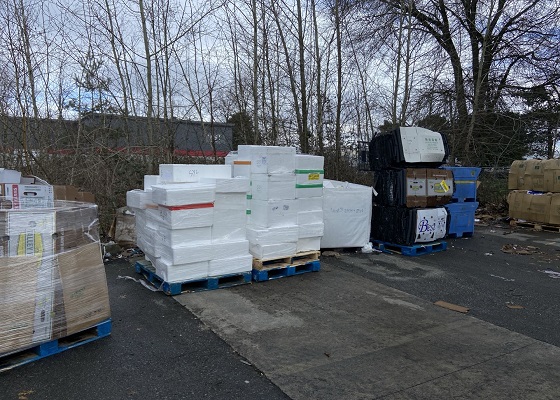
Recycling performance is improving, but it is still far from “automatic.” Multiple European industry references point to an EPS packaging recycling rate around 40% in the EU, which means the majority still relies on disposal routes rather than true material recovery. For supermarket operators, the gap is rarely about whether EPS is technically recyclable; it is about whether the site can store, handle, and ship low-density foam economically enough for a recycler to want it.
That is where an EPS compactor becomes a practical tool for fresh supermarkets. By compressing loose foam into dense blocks, compactors change the economics of collection: fewer pickups, less warehouse space consumed by waste, and a cleaner, safer back room. GREENMAX markets EPS compactors specifically around this problem—turning bulky “white waste” such as fish boxes into a dense, tradable output stream. Instead of paying repeatedly for air-volume hauling, supermarkets can aggregate compacted blocks and send them on a predictable schedule to regional recyclers.
One GREENMAX EPS compactor case that maps closely to the fresh supermarket context comes from Sheng Siong, a major supermarket chain in Singapore. The project description focuses on upgrading how the chain treats EPS waste from fruit and vegetable packaging and other in-store sources, with GREENMAX equipment used to improve on-site handling and move foam toward recycling rather than disposal. The operational logic is familiar to any fresh retailer: EPS waste appears every day, storage space is limited, and staff time is expensive. When compaction happens near receiving or unpacking zones, foam stops spreading into aisles and corners, and waste movement becomes part of a controlled routine rather than a recurring clean-up event. Although every site’s numbers differ, the business outcome is consistent: once EPS is densified, recycling is no longer “a special project,” it becomes a repeatable logistics step.
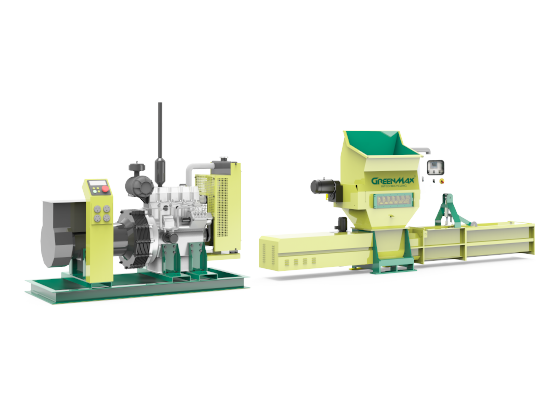
A second GREENMAX EPS compactor case, widely relevant to supermarkets with strong seafood turnover, is from Muijs Seafood in the Netherlands, where the company added additional GREENMAX equipment as volumes grew and as it aimed to handle more used fish boxes through on-site compaction. Even if Muijs is not a supermarket itself, it sits in the same fresh supply chain that supermarkets depend on—moving chilled seafood at scale and generating large quantities of EPS fish boxes that must be managed quickly and hygienically. For retailers, this matters because the most stable recycling outcomes often happen when both upstream suppliers and downstream retail nodes adopt similar practices: keep EPS streams segregated, remove obvious contaminants, and compact consistently so recyclers receive a predictable format.
So how should a fresh supermarket think about “quantity” and “recycling rate” in a way that is operationally meaningful? The quantity problem is straightforward: if a national market consumes tens of millions of EPS fish boxes annually—as the UK figure suggests—then even a small slice of that flow passing through a single supermarket chain can translate into persistent daily EPS generation at store or depot level. The recycling rate problem is equally practical: when a region’s EPS recycling rate is cited around 40% on average, it implies that a large portion of EPS still fails to reach recycling because collection and preparation are not efficient enough. A compactor is not a “nice-to-have” in that context; it is often the enabling step that makes a higher local recovery rate achievable for a specific business.
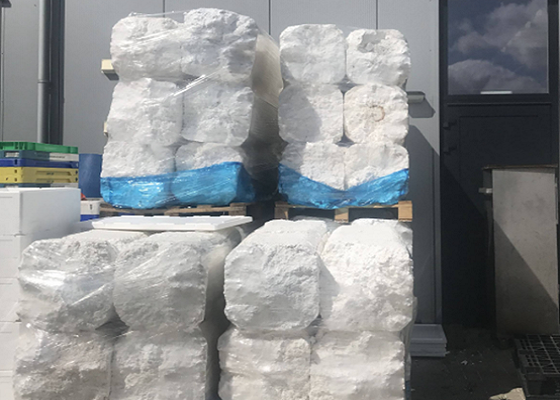
In fresh supermarkets, the best results usually come from treating EPS as its own dedicated stream. Seafood boxes should be drained and kept as dry as possible, obvious non-foam materials should be removed when feasible, and compaction should happen close to where the packaging is unpacked. Done well, the back room stops behaving like a foam balloon, collections become less frequent, and recyclers are more willing to quote stable terms because they are receiving dense blocks rather than loose, contaminated foam.
If your business is looking to make EPS recycling practical at store, depot, or distribution-centre scale, GREENMAX EPS compactors are designed for exactly this retail reality—high volume, low density, and constant daily generation tied to fresh food packaging.