 Select Language
 English
From Bulky Foam Waste to Recyclable Value: Three GREENMAX Overseas Cases
EPS, EPP and XPS foam are widely used in appliance packaging, automotive component protection and building insulation. These materials provide excellent cushioning and thermal performance, but they create a major waste-management challenge after use. Foam is lightweight yet extremely bulky, which means loose waste quickly fills warehouses, containers and collection vehicles. For companies that generate foam continuously, frequent disposal can lead to high labour, storage and transport costs.
Foam recycling becomes more practical when the waste is reduced in volume at the source. After crushing, compacting or melting, loose foam can be converted into dense blocks or ingots that are easier to store, load and transport. The processed material can then be sent to downstream recyclers and turned into recycled plastic pellets for manufacturing new products.
However, different foam materials require different recycling technologies. The following projects in Canada, Germany and Portugal show how GREENMAX machines are selected according to the material type, waste volume and recycling objective.
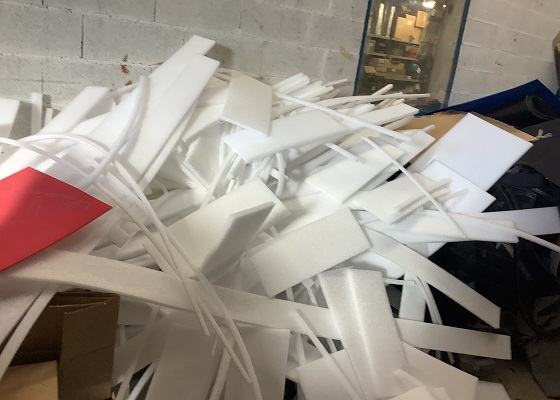
The first project comes from The Brick, a major Canadian furniture and appliance retailer. Its distribution facilities receive televisions, refrigerators, washing machines, furniture and other large products protected by EPS packaging. Once the goods are unpacked, large quantities of clean EPS foam remain.
Before installing recycling equipment, the loose foam occupied valuable warehouse space and required frequent collection. Because most of the volume consisted of air, trucks carried very little actual material during each trip. The company introduced a GREENMAX MARS M-C300 hot-melt densifier to improve the process.
The M-C300 first crushes the EPS and then feeds it into a heated screw system. The foam is melted and extruded into dense ingots, achieving a much higher volume-reduction ratio than ordinary storage or manual breaking. The compact ingots can be stacked safely and transported in larger quantities.
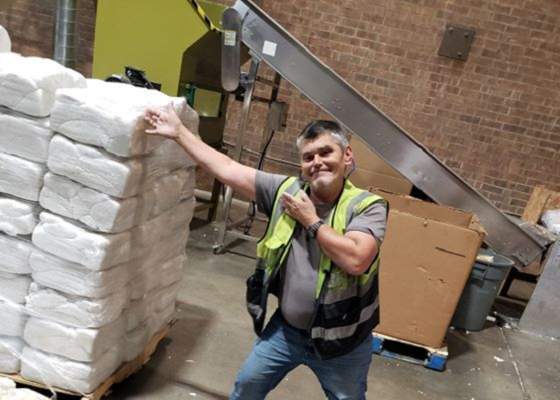
Over the course of the recycling programme, The Brick sold more than one million pounds of recycled EPS material and generated more than USD 200,000 in recycling revenue. The customer later purchased additional GREENMAX equipment to expand its processing capacity. This case demonstrates that large retailers and distribution centres can transform packaging foam from a disposal burden into a recyclable material with commercial value.
The second project involves a German Tier 1 automotive supplier that generated approximately 35 tonnes of waste EPP packaging each year. EPP is commonly used to produce reusable trays, dividers and protective inserts for door systems, electronic components and other precision automotive parts. Its elasticity and impact resistance make it ideal for transportation, but these same properties make it difficult to compact.
When EPP trays become damaged, worn or unsuitable for new component sizes, they can no longer remain in circulation. Ordinary compression may produce unstable blocks because the material tends to rebound. The German customer therefore selected a GREENMAX ZEUS Z-C200 foam compactor.
The Z-C200 combines crushing, screw compression and surface-fusion technology. After the EPP is compressed, the outer surface of the block is lightly fused, helping it retain its shape. This allows the company to produce dense, stackable blocks that are easier to store and transport.
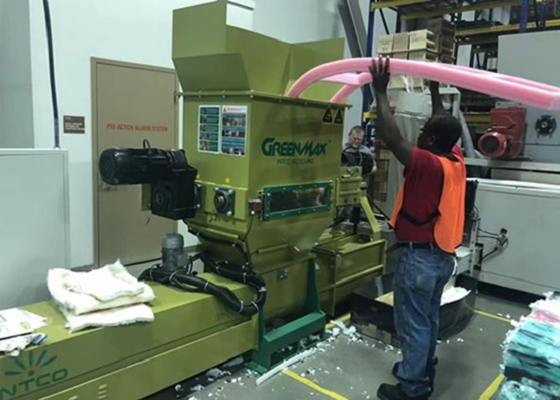
The recycling project also improved warehouse 5S management and reduced dependence on frequent external waste collections. For automotive suppliers, these benefits are increasingly important because waste handling is connected not only to operational costs but also to environmental reporting, supply-chain standards and circular-economy targets.
The third project is located at Iberfibran, a Portuguese insulation manufacturer that produces XPS boards. During cutting, trimming and product finishing, the factory generates clean strips and irregular offcuts. Although this production waste is suitable for recycling, loose XPS occupies large areas and is uneconomical to transport.
The customer installed a GREENMAX APOLO A-C200 cold compactor. Unlike a hot-melt densifier, the machine reduces foam volume through mechanical pressure without fully melting the material. The XPS is crushed and compressed into dense blocks that can be stored more efficiently and delivered to downstream recyclers.
During commissioning, GREENMAX engineers adjusted the cutting process, screw-running time and cooling arrangement according to the actual characteristics of the XPS waste. These changes helped stabilise the compression process and improved the final block quality. The project shows the importance of matching machine parameters to the density, shape and behaviour of the customer’s material.
These three cases also explain why machine selection should not be based on capacity alone. Clean EPS packaging is often well suited to hot-melt densification because the resulting ingots are highly compact and economical to transport over long distances. Elastic EPE and EPP require a system that can control rebound and maintain block stability. Clean production offcuts such as XPS can often be processed effectively through cold compaction.
.jpg)
Source separation is another essential part of foam recycling. Different foam types should be stored separately, while tape, cardboard, metal parts, labels and other contaminants should be removed. Wet or contaminated packaging should be drained and cleaned before processing. Cleaner material generally produces better blocks and has greater value in the recycling market.
After volume reduction, recycled foam can be processed into plastic pellets and used to manufacture picture frames, decorative mouldings, building products, plastic profiles and other goods. GREENMAX also supports customers with material testing, machine selection, installation, commissioning, parameter adjustment and recycled-material purchasing channels.
The Canadian, German and Portuguese projects demonstrate that effective foam recycling requires a solution designed around the actual waste stream. With the right GREENMAX machine, companies can reduce storage pressure, lower transport costs, improve site management and return valuable foam materials to the recycling chain.