
 Select Language
 English
EPS Foam Melting Machines for Foam Recycling
EPS foam is commonly used to protect appliances, electronics, furniture and other products during transport. It is also found in insulation boards, fish boxes and cold-chain packaging. Once the packaging has served its purpose, the foam quickly takes up warehouse space because most of its volume is air.
An EPS foam melting machine reduces this volume before the material leaves the site. Instead of transporting truckloads of loose foam, businesses can turn it into dense ingots that are easier to stack, store and send to a recycler.
How EPS Foam Is Densified
The process begins by feeding loose EPS into the hopper. The crushing unit breaks it into smaller pieces, which then pass through a heated screw. As the material melts, the screw pushes it forward and extrudes it into dense polystyrene ingots.
A GREENMAX EPS foam melting machine can reduce the original foam volume by up to 90:1. This is particularly useful for companies that generate EPS regularly and otherwise need frequent waste collections. With more material packed into each load, transportation becomes more practical and the storage area is easier to manage.
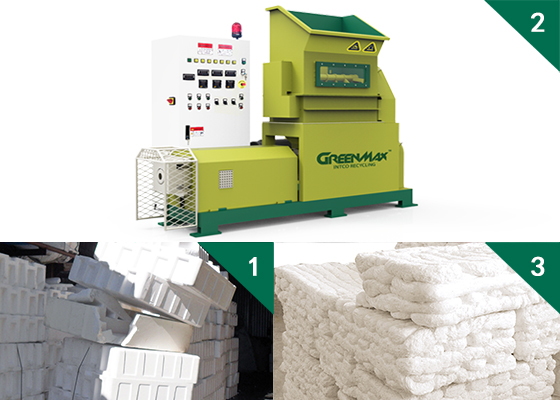
EPS Waste the Machine Can Process
The machine can handle EPS protective packaging from appliances, electronics and furniture, as well as EPS insulation offcuts, fish boxes, cold-chain containers and clean production scrap. The foam should be separated by material type before processing, since different foams do not always require the same temperature or screw settings.
GREENMAX provides several machine sizes for different processing volumes. Heating temperature and screw speed can be adjusted according to the density and condition of the EPS, while exhaust and odor-control systems can be added when the working environment requires them.
Recycling the Densified EPS
Once the EPS has been melted into ingots, it requires much less space and can be transported more economically. A downstream recycler can then crush and pelletize the material to produce recycled polystyrene pellets.
These pellets are used in rigid plastic products such as picture frames, decorative mouldings and plastic profiles. In this way, EPS foam melting machine provides the volume-reduction step between loose packaging waste and reusable polystyrene material.
EPS foam melting machines are generally suited to appliance and electronics manufacturers, foam factories, logistics centers, furniture retailers and recycling companies with a regular supply of EPS waste. The right model depends mainly on the type of foam, the amount generated and how many hours the machine needs to run each day.
FAQ
1. How much can an EPS foam melting machine reduce foam volume?
A GREENMAX EPS foam melting machine can reduce loose EPS volume by up to 90:1. The actual result depends on the foam’s density and condition.
2. What types of EPS waste can the machine process?
It can process EPS protective packaging, insulation board offcuts, fish boxes, cold-chain containers and clean production scrap.
3. What happens to EPS after melting?
The machine turns loose EPS into dense ingots. These ingots can be granulated into recycled polystyrene pellets and used to manufacture picture frames, decorative mouldings and plastic profiles.