
 Select Language
 English
EPS Densifier: Reshaping the recycling model of furniture stores and logistics companies.
In the operations of furniture stores and logistics companies, EPS packaging is widely used to protect fragile items. However, after fulfilling their purpose, these packages become cumbersome waste, taking up significant space and being difficult to handle. The emergence of EPS densifier has brought innovation to the entire sales, transportation, and recycling process.
On the sales side, furniture stores use EPS to package furniture, ensuring that products are delivered safely to customers. However, after customers unpack the items, the EPS waste accumulates, taking up storage space in the store and increasing cleaning costs. For example, the well-known American furniture chain Rooms To Go had a revenue of $1.75 billion in 2007, and used a large amount of EPS and other materials for furniture packaging. Since 1991, the chain has implemented a recycling program to process the waste at its five large distribution centers.
.jpg)
When transporting furniture and various types of fragile items, EPS packaging is an indispensable protective barrier for logistics companies. After transportation, a large amount of EPS packaging waste is generated. In the past, this waste was often discarded in landfills due to its large volume and low recycling value, wasting resources and putting pressure on the environment. Today, with the help of EPS densifiers, logistics companies can process recycled EPS waste in a timely manner. The equipment compresses the loose EPS waste into high-density blocks, reducing the volume to 1/90 or even less of the original, significantly lowering storage and transportation costs.
When the EPS densifier is in operation, it uses mechanical pressure to compress EPS waste, causing the internal bubble structure to collapse and air to be expelled, thus achieving a significant reduction in volume. Some advanced equipment also integrates a heating function, applying thermal melting to the EPS during the compression process, further enhancing the compaction effect and the quality of the recycled material. The block materials made from EPS processed by the compactor can be sold to specialized recycling companies for use in producing picture frames, decorative strips, building insulation materials, etc., thus realizing resource recycling.
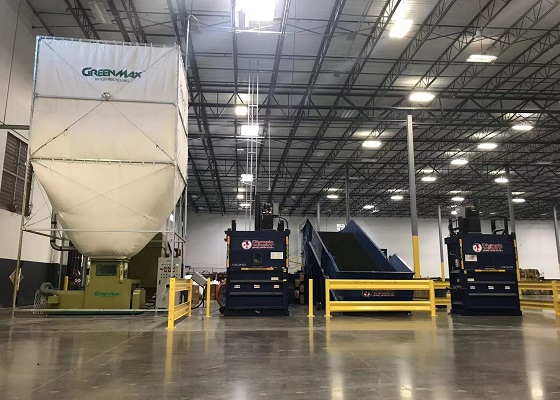
Taking a large appliance chain store in the United States as an example, previously, the EPS waste generated by their delivery service was sent directly to the landfill, filling a 40-yard dumpster in just a few days, leading to high waste disposal costs. After adopting the EPS densifier, they only need to operate it for 2 hours a day to recycle all the EPS waste, and now, they only need to empty the dumpster once a month, saving a significant amount of costs.
The EPS densifier connects the sales, transportation, and recycling processes between furniture stores and logistics companies, transforming what was once waste into usable resources, thereby lowering operational costs and promoting an environmentally friendly concept, providing strong support for the sustainable development of the industry.
.jpg)