
 Select Language
 English
EPS Compactor vs Densifier: Which One Fits Your Foam Waste?
An EPS compactor and a foam densifier solve the same basic problem: loose foam occupies too much space to store and transport economically. The difference is how each machine reduces the material and what kind of output it produces.
A compactor uses mechanical pressure to form dense blocks without melting the foam. A densifier crushes and heats the material before extruding it into solid ingots. For businesses comparing these two options, the decision should be based on the foam type, monthly volume, transport distance, available utilities and the requirements of the downstream recycler.
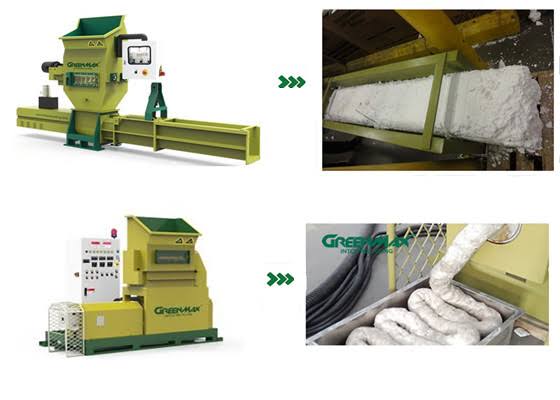
How EPS Compactor Processes Foam Waste
An EPS compactor crushes loose foam into smaller pieces and moves the material through a screw compression system. Pressure removes much of the air and forms the foam into compact blocks.
GREENMAX APOLO series can reduce EPS volume by up to 50:1. Because the process does not melt the material, it generally uses less energy than hot-melt densification. The equipment is often selected for EPS packaging, insulation offcuts and molded production scrap.
Cold-compacted blocks still retain some of the original cellular structure. They are denser than loose foam but less dense than hot-melt ingots. Whether this output is suitable depends on the transport distance and the form accepted by the downstream recycler.
How Foam Densifier Processes Foam Waste
A foam densifier also begins by crushing the material. The smaller pieces then enter a heated screw section, where the foam softens and releases the air trapped inside its structure. The machine extrudes the material as dense ingots.
GREENMAX hot-melt foam densifier can reduce foam volume by up to 90:1. The output requires less storage space and allows more material to be loaded into each shipment.
Hot-melt processing is often considered when a site faces high transport costs, limited storage space or foam with strong rebound, such as EPE. Selected configurations can also process EPS, XPS or EPP, but the material should be tested before the equipment is confirmed.
EPS Compactor vs Foam Densifier
|
Comparison |
EPS compactor |
Foam densifier |
|---|---|---|
| Processing method | Crushing and mechanical compression | Crushing, heating and extrusion |
| Heat applied | No | Yes |
| Maximum volume reduction | Up to 50:1 | Up to 90:1 |
| Typical output | Compressed foam blocks | Dense melted ingots |
| Energy use | Generally lower | Higher because heat is required |
| Storage and transport density | Moderate | Higher |
| Common application | Clean EPS packaging and production scrap | EPS, EPE and other tested foam streams requiring greater volume reduction |
| Site consideration | Space for block formation and storage | Ventilation, power supply and ingot cooling area |
The terms “compactor” and “densifier” are sometimes used differently across the industry. When comparing suppliers, check whether the machine uses only mechanical pressure or includes a heated screw. The process and final output are more important than the product name alone.
Test the Foam Before Choosing the Equipment
EPS packaging can vary in density, shape and expansion ratio. EPE, EPP and XPS behave differently during crushing, compression and heating. A machine selected only from a product photograph or nominal capacity may not reflect the actual waste stream.
GREENMAX can test representative samples to evaluate feeding, crushing, block formation or ingot quality. The final recommendation can then account for the material type, monthly volume, available processing time and downstream requirements.
For clean EPS with a nearby recycling outlet, an EPS compactor may provide sufficient volume reduction with lower energy use. Where transport distance, storage space or resilient foam materials create greater pressure, a foam densifier can provide a denser and more practical output.
FAQ
1. Does a foam densifier produce denser output than an EPS compactor?
Yes. A hot-melt foam densifier can reduce volume by up to 90:1, while a GREENMAX cold compactor can reach up to 50:1. Actual results depend on the material.
2. Can both machines process EPE foam?
A hot-melt foam densifier is commonly used for EPE because the material has strong rebound. Compactor suitability depends on the EPE type and machine configuration, so testing is recommended.
3. Which machine uses less energy?
An EPS compactor generally uses less energy because it relies on mechanical compression without a full hot-melt process. The overall cost should also include storage and transportation.