 Select Language
 English
Closing the Loop on Foam Waste with an EPS densifier: Where It Matters Most
Expanded polystyrene (EPS) is famous for being mostly “air,” which is exactly why it becomes such a stubborn waste problem. A small amount of protective packaging or insulation offcut can fill an entire bin, overwhelm storage space, and make hauling uneconomical. Industry groups often describe EPS as being about 98% air by volume, which helps explain why logistics—not chemistry—is usually the biggest obstacle to recycling.
An EPS densifier solves that logistics bottleneck by turning loose foam into dense, stackable output that can move through normal freight channels. In practice, densification is done either through mechanical compaction (cold densifying) or through heat-assisted melting and extrusion (hot melting densifying). GREENMAX’s hot-melt densifier workflow, for example, is designed to crush, heat/melt, then compress and extrude EPS into dense blocks or “logs,” reducing volume dramatically and making downstream handling much easier.
When we talk about where EPS is used the most, three industry arenas dominate real-world waste generation: building and construction (insulation boards and building products), protective packaging for electrical/electronics and appliance supply chains, and temperature-controlled packaging in food distribution—especially seafood logistics. Independent materials references consistently point to packaging and construction as the two major application pillars of EPS, while industry explainers commonly cite insulation materials and fish boxes as everyday, high-volume uses.
.jpg)
In the building and construction sector, EPS is widely used in insulation systems, which creates two distinct waste streams: bulky offcuts from cutting and shaping boards, and fine dust generated during trimming and processing. This is a perfect use case for an EPS densifier because both waste types are hard to store and expensive to ship in loose form. GREENMAX has positioned an “all-in-one” approach for insulation board plants by pairing a foam densifier (such as the M-C200) with a feeding screw/auger system so manufacturers can process both block scrap and lightweight EPS dust in a more continuous, controlled way. A related example is Hirsch Isolation, an EPS manufacturer that invested in a customized GREENMAX EPS foam densifier for its warehouse and workshop and then routed densified output into a buyback/recycling loop, aiming for a closed-loop pathway instead of paying to dispose low-density scrap.
In electrical, electronics, and appliance supply chains, EPS appears everywhere as molded protective packaging around compressors, panels, and shock-sensitive components. The waste problem shows up at unpacking points: assembly plants, distribution hubs, and service/returns operations where packaging volumes spike and loose foam quickly becomes a safety and congestion issue. Here, an EPS densifier works best when it is placed where the waste is created—right beside the unpacking or packaging line—so operators can densify continuously rather than letting foam accumulate. GREENMAX has documented appliance-focused usage where a company used a GREENMAX Styrofoam densifier M-C200 to reduce bulky EPS into dense ingots, highlighting a high melting compression ratio and the resulting improvements in storage and transport efficiency. In parallel, GREENMAX’s broader positioning emphasizes that densified blocks have clearer downstream value, because consistent density and lower contamination simplify resale and reprocessing economics for recyclers and end users.
.jpg)
Food distribution—especially seafood—forms the third high-volume arena because EPS fish boxes and insulated containers are widely used to protect freshness and temperature during transport. That usage translates into steady, wet, sometimes contaminated EPS waste at seafood processors, wholesale markets, and cold-chain distribution nodes. This is another scenario where densification can flip disposal into recovery: densified EPS is easier to store hygienically, ship in fewer loads, and sell into recycling channels. GREENMAX has specifically discussed supplying densifier solutions for seafood distributors dealing with EPS “foam #6” packaging in refrigerated product logistics. There are also GREENMAX examples focused on EPS recycling system where the equipment compresses EPS into dense blocks with large volume reduction, directly targeting the biggest pain point: the cost of moving “air.”
Across all three industries, the practical value of an EPS densifier is that it converts a low-density nuisance into a standardized intermediate material. Once EPS becomes dense blocks or ingots, it can be aggregated, traded, and transported to processors that convert it back into usable polystyrene feedstock and products. GREENMAX’s message is consistent across applications: densification improves site cleanliness and space utilization, reduces haul frequency, and helps unlock recycling outlets that are otherwise uneconomical when EPS is loose.
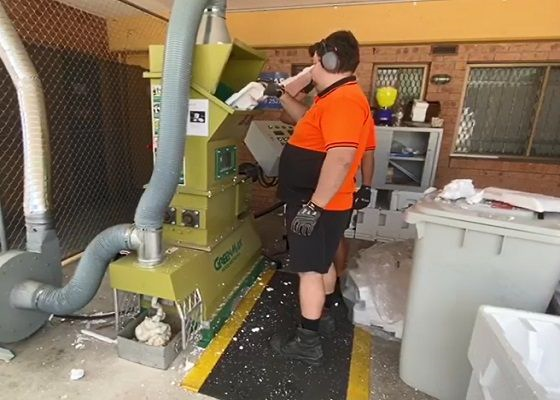
Ultimately, “recycling” EPS is less about a single machine and more about building a reliable pathway from generation to reuse. The three biggest EPS-using sectors—construction insulation manufacturing and installation, electronics/appliance packaging flows, and food/seafood cold-chain packaging—share the same constraint and the same opportunity: if you can densify on-site, you can ship value instead of shipping air.