
 Select Language
 English
EPS Melting Technology: An Efficient and Innovative Path to EPS Foam Recycling
EPS foam, due to its lightweight, shock-resistant, and thermally insulating properties, is widely used in express packaging, appliance cushioning, and building insulation. However, due to its bulk and difficulty in degrading, the large amount of discarded EPS foam has become a major source of "white pollution." Traditional recycling methods, such as mechanical crushing followed by landfill or simple incineration, not only have low resource utilization rates but also cause secondary pollution. The emergence of EPS melting technology provides a new, efficient, and environmentally friendly path for EPS foam recycling. By melting and reducing the volume of EPS foam and converting it into recycled raw materials, it achieves resource recycling.
.jpg)
Traditional Difficulties and Technical Requirements for EPS Foam Recycling
The physical properties of EPS foam present numerous challenges in its recycling. For one thing, EPS foam has an extremely low density, typically weighing only 10-20 kilograms per cubic meter. Large piles of discarded foam take up enormous space. If not promptly processed, they can quickly fill up entire warehouses. During transportation, unprocessed EPS foam has a very low loading rate, with a truck carrying less than one ton. Transport costs are 5-10 times higher than for ordinary cargo, resulting in low economic returns for recycling companies.
On the other hand, traditional recycling technology has obvious shortcomings. Although mechanical crushing technology can break down EPS foam into small pieces, the reduction ratio is only about 10:1, which still does not solve the transportation and storage problems; incineration releases toxic gases such as dioxins, severely polluting the air, and has been strictly limited by most countries; landfill disposal takes hundreds of years to degrade and may also release harmful substances into the soil and groundwater due to rainwater runoff. According to statistics, less than 30% of the EPS foam generated globally each year is effectively recycled, while the rest is disposed of through landfilling or illegal dumping, putting enormous pressure on the ecological environment.
Against this backdrop, there is an urgent need in the market for a recycling technology that can achieve efficient reduction of EPS foam, environmentally friendly treatment, and economic feasibility, leading to the emergence of EPS melting technology.
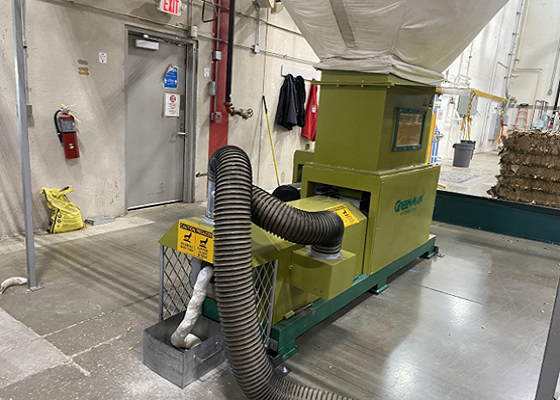
The working principle and core advantages of EPS melting technology
EPS melting technology is a process where EPS foam is heated to a molten state, significantly reducing its volume and transforming it into recycled raw materials. The core process includes three stages: pre-treatment, melting, and molding. The compressed EPS is easier to store, transport, and process in subsequent steps.Practical applications and development prospects of EPS melting technologyTypical application scenarios
In Europe, many countries have widely adopted EPS melting technology to handle urban EPS foam waste. An environmental company in Berlin, Germany, has introduced multiple large EPS melting machines that can process 50 tons of EPS foam daily. The dense blocks produced are sent to plastic processing plants, where they are made into recycled plastic pellets for use in automobile parts manufacturing. This project not only solves 30% of Berlin's EPS foam waste problem but also brings the company an annual revenue exceeding one million euros.
With the increasing strictness of environmental protection policies and the popularization of circular economy concepts, the market demand for EPS melting technology will continue to grow. In the future, this technology will develop in three directions: first, miniaturization of equipment, developing portable EPS melting devices suitable for communities and small businesses to enhance recycling convenience; second, smart upgrades, achieving real-time monitoring of equipment operating status and fault warning through IoT technology to improve processing efficiency; third, process optimization, researching low-energy melting technologies to reduce unit processing costs while enhancing the quality of recycled materials and expanding their application in high-end product fields.
In addition, policy support will accelerate the promotion of EPS melting technology. Many countries have introduced subsidy policies to encourage companies to purchase EPS melting equipment, such as France providing a 30% subsidy for equipment purchases to companies using this technology. In some regions of our country, EPS melting projects have also been included in the scope of special environmental protection funds. These measures will further lower the application threshold for enterprises and promote the scaled development of the EPS foam recycling industry.
.jpg)