 Select Language
 English
Current Waste Polystyrene Foam Recycling Method
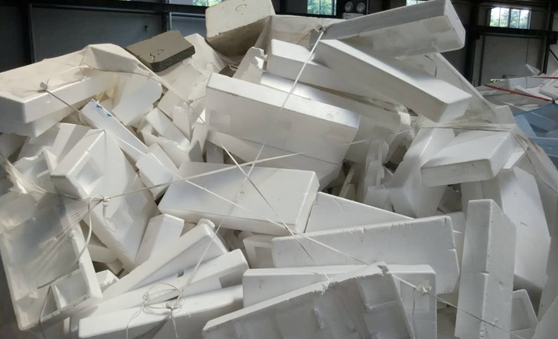
Polystyrene foam, such as EPS and XPS, is widely used in protective packaging, insulation boards, food containers and transportation cushioning due to its light weight, low cost and strong shock‐absorption properties. However, its extremely low density, bulky structure and long degradation cycle make collection and disposal difficult, creating global environmental and logistical challenges. Several recycling routes have been explored, among which physical recycling has proven the most practical and commercially scalable.
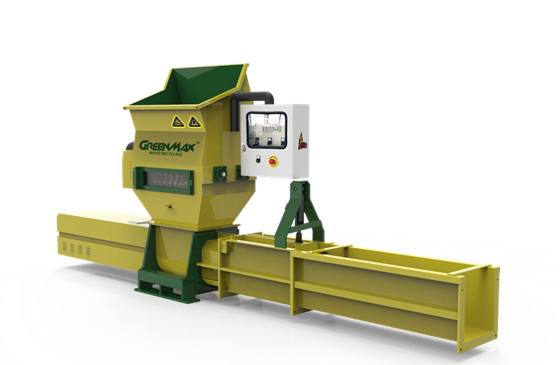
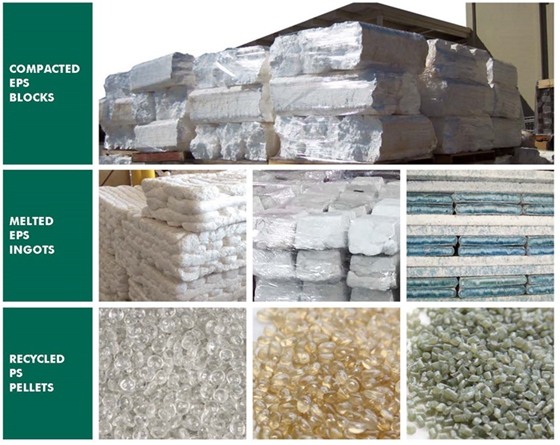
The physical recycling method adopted by many GREENMAX customers relies on mechanical treatment rather than chemical reaction. Waste foam is collected, crushed, thermally softened and compacted using specialized GREENMAX foam compactor. During this process, the volume of the foam can be reduced by more than fifty percent, forming dense blocks or pellets that are much easier to store and transport. These compressed materials are then melted and pelletized to produce recycled polystyrene pellets.
The regenerated pellets are reused in a wide range of downstream products, including picture frames, decorative trims, hangers, insulation components, building accessories and stationery or appliance parts. This approach avoids the use of solvents, eliminates toxic emissions, maintains the basic physical properties of polystyrene, and has low energy consumption and high processing efficiency. Because the equipment is mature and the operating cost is relatively controllable, it is well suited for industrial‐scale recycling and supports a circular economy model.
In contrast, incineration with energy recovery is mainly used as a disposal method rather than true recycling. When polystyrene is burned in dedicated high‐temperature furnaces, the released heat can partially replace fossil fuels used in boilers, power generation or metallurgical processes. However, if combustion is incomplete or the furnace is not designed for plastics, harmful substances such as styrene and unburned polymers may be released, causing secondary environmental pollution. Moreover, the material value is completely lost and the overall cost of safe incineration remains high.
Chemical pyrolysis is another route, where polystyrene is decomposed at high temperatures to recover styrene monomers and aromatic compounds. In theory, this enables high‐quality recycling, but in practice the yield is often low and the reactors, heating systems and gas treatment equipment are expensive to operate and maintain, limiting large‐scale application.
Solvent dissolution and regranulation is also used in some regions. In this process, foam waste is dissolved in organic solvents and directly processed into spherical recycled pellets without high‐temperature cracking. The properties of the recycled material can be close to virgin suspension‐polymerized polystyrene. However, most effective solvents, such as benzene derivatives, are toxic, while non‐toxic ester‐based solvents have strong odors and high costs, making the process unsuitable for mass production.
Overall, physical Polystyrene recycling—especially through the compaction and pelletizing practices implemented by GREENMAX customers—offers a mature, economical and environmentally sound solution that preserves material value and minimizes secondary pollution. If you’d like this adapted into a brochure, PPT content or bilingual version, just let me know!